понедельник, 18 мая 2009 г.

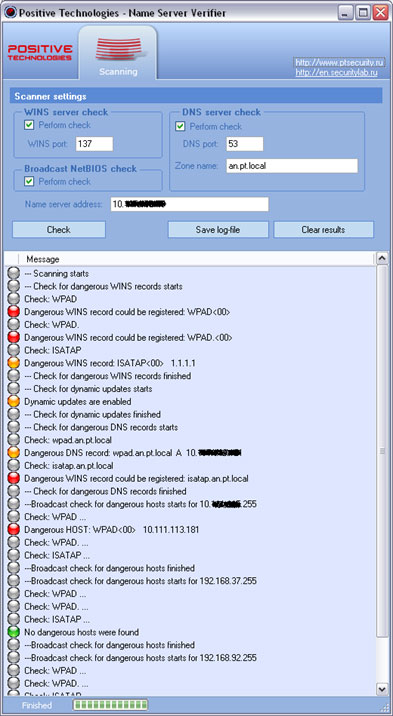
Tool for WINS and DNS (MS-09-008)

The utility is used to detect potentially dangerous entries in DNS and WINS services databases. The utility also allows local network scanning to detect hosts with dangerous NetBIOS names. If system administrators and security administrators use the utility regularly then it allows controlling potentially dangerous entries in name servers and availability of hosts with dangerous NetBIOS names in local network.


Detail information could be found in the article by Sergey Rublev and on SecurityLab:

http://www.securitylab.ru/news/extra/380522.php

http://www.securitylab.ru/_download/articles/wpad_weakness_en.pdf

Download here:
http://www.ptsecurity.ru/download/wpadcheck_en.zip

среда, 13 мая 2009 г.

Compliance management vs Risk management

If we consider the question of request compliance in terms of risk analysis, i.e. assume that:
threat – violation consequences described by the compliance enforcement agency (CEA :).

vulnerability – incompliant to requirements
attack – checks made by the CEA
counter-measure - compliant to requirements

so there is practically an unexampled situation – we have all necessary basic data for quantitative risk analysis based on the classical technique ARO x SLE = ALE.

http://www.windowsecurity.com/articles/Risk_Assessment_and_Threat_Identification.html

We have:

ARO – probability of CEA checks
SLE - violation consequences described by the law or CEA

This interesting situation not only proves that school rules still sometimes work, but also a great benefit of compliance as an engine of information security.

Lets consider some examples that are now widely known - Russian Federal Law 152 (On Personal Data) and PCI DSS.

PCI DSS

This is quite simple, as Visa and other payment systems decided not to taunt business and allow to shift action plan because of events in the world economy now. This is a delay in attack implementation in several years. Unexampled situation when you exactly know that this particular attack did not take place during a year. Or a couple of years. Just imagine a license from virus attacks or hardware theft for a year… A great thing!

So:

threat - fines (N x K$) or loss of operation prohibition (let it be also N x K$ for ease), SLE;
vulnerability - incompliant to requirements (PCI DSS);
attack – CEA (Visa, Mastercard, etc) response to action plan deviation (the probability that it will take place, ALE - 0 times a year)

Totally, we have:

Risk = (N x K$) x (0) = 0

Tat is that you can do nothing!!!

But! The key condition is that you have action plan. Accordingly, you should create it. By yourself or with QSA – as you wish. Unfortunately I do not have information about regulator response if there is no PCI DSS action plan, but I think in this case SLE is about counter-measure (audit) costs.

Federal Law 152

In this case everything is easy also.

threat - some variants

1. Administrative responsibility - fines
2. Suspension or termination of personal data processing in the company is the period of idle time/degradation of constrained business processes before elimination. I think you can take minimum 1/6 of a year.
3. Company and (or) its head is made responsible for criminal (civil, disciplinary, etc.) offence -– a catastrophe.
4. Licenses suspension or revocation for the company basic activity – closer to catastrophe in the current situation.

attack – check by CEA

With regard to newness and interest for regulator and the possibility of initiation from the outside (an application), the probability that the attack will be conducted in 2010 could be taken equal to 1.
For more detailed calculations by regions and business brunches the following statistics could be used:

http://community.livejournal.com/personal_data/721.html

Totally, we have (worse case scenario):

Risk = (the value of business) x (1) = (the value of business)

That is: there is a problem, and you have to solve it.

PS. There is no need to make far-reaching conclusions. It‘s just a funny story. We didn't sell FL-152 consulting :)
понедельник, 20 апреля 2009 г.

Microsoft has published regular Security Intelligence Report.

Russia is among leaders by infected computers percentage:
The infection metrics is about 21,1 for 1000 runs of "cleaner" , an world average index is 8,6. A very strange index.


It is possible that the index is strongly concerned with a possibility to infect different platforms:


I think nobody is surprised that a lot of home users with XP SP0, SP1 are afraid to update it because they are should that their cracked Windows versions will not further work. But will they have Malicious Software Removal Tool? Will a “master” bring on a floppy disk? Rather, something from Kaspersky or DrWeb.

This is a very strange situation. Can it really be corporate employees ?

PS. Actually this is a wonderful report.
The most common threat in Russia – Taterf which is spread through shared folders, in USA - Win32/Renos and Win32/Zlob. There are a lot data about Conficker in the report, but it is missed in statistics first lines.

Is it a wonder?

воскресенье, 12 апреля 2009 г.

Security in our life

I has taken a flight from Domodedovo airport (Moscow) recently, and thought a lot…
And my thoughts were hard… Hope, only in Britain and only on submarines.


PS. If somebody do not recognize – this is Symantec - Kido/Conficker/Downadup.

четверг, 19 марта 2009 г.

Webspider. Express vulnerability assesment

Concept preview of Webspider express security scanner (pure AJAX :) has been recently published – this is a tool that allows analyzing in seconds the software which is the most frequently used by attackers. The system is intended to make protection express analysis of Internet and Intranet users, users of electronic commerce systems and Internet provider clients.

You can test it here:

http://www.securitylab.ru/addons/webspider3/fast_check.php


The current version is able to detect a vulnerability in popular ActiveX components and plug-ins, Mozilla Firefox and Opera browsers, Java and Adobe Flash applications and also MS07-042, MS08-069 and MS09-002 updates.
We plan to publish a detailed article about the used techniques in April.

It's just preview, so be indulgently.

вторник, 10 марта 2009 г.

Positive Technologies Reasearch Lab

This year we decided to resume the publication of vulnerability details detected during researches and penetration testing.

http://en.securitylab.ru/lab/

In 2006, because of a number of reasons, we decided to shift the burden of publishing vulnerability details to software vendors and stop publishing the details about previously detected problems. However, many customers ask us to assist in vulnerability elimination in third-party vendor software. This induces us to resume the process.
The most interesting current problem (in my opinion) is a number of vulnerabilities in VMWare that allows attackers to gain access from guest to host OS. And right to the kernel.

I personally treated different methods to eliminate vulnerabilities in third-party vendor software, from Full-Disclosure extremism to selling vulnerabilities in the “white” market, for example, iDefense (http://labs.idefense.com/vcp/). Some thought are available here:
http://www.securitylab.ru/analytics/241826.php (Russian)

вторник, 24 февраля 2009 г.

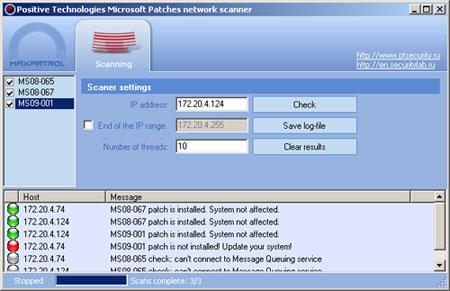
We’ve published a network utility to check that security updates from MS08-065, MS08-067 and MS09-001 are installed in the system. The utility does not need administration privileges and works in pentest mode.
Feedback on the previous releases was quite positive, we decided to upgrade.


Additional info:
http://www.securitylab.ru/news/extra/368760.php

Downloads:
http://www.ptsecurity.com/download/pt-check-09-001.zip